Pages

Showing posts with label low-budget. Show all posts

Thursday, April 25, 2013

What Would You Do?: One Week (2008)

I debated about whether or not to even include this film on this blog.  After all, it did earn Joshua Jackson a Genie Award (that's the Canadian equivalent of the Oscars for all my American friends), and another nomination for Liane Balaban.  Still, with all its acclaim, this gem of director Michael McGowan's remains relatively unheard of outside its native Canada.

The film focuses on Ben Tyler, a man who at the very start of the film is diagnosed with stage 4 cancer.  However, rather than being a melodrama where Ben is shown fading away in a hospital bed, loved ones at his side, this film has its protagonist take a radical approach.  He decides on a whim to purchase a motorcycle and just ride.  The trip begins as a two-day excursion, but transforms into an cross-country journey from Toronto to Vancouver, Ben meeting a cast of characters along the way.

Photo credit: timeslikethose

The whole idea behind this film and Ben's reasoning for his trip did nothing but inspire me.  For being a film about someone with cancer, I never once felt depressed.  It balances the profound moments with a lot of humor, and the people Ben meets as he goes are all unique and interesting, each with their own story.

Ben's frequent stops at various sites along his path got me thinking.  Where would I go if I just decided to go on a week-long trip one day?  How would I travel?  What would I see?  Maybe a cross-country trip of my own?  I could start in New York, pass through all these different places I've never stepped foot in before, and finally end at the foot of the Pacific.  Who knows?

My question is...Where would you go?

Friday, April 5, 2013

I'm the Lord of This World: Crazy As Hell (2002)

One genre of film that has become increasingly popular in recent years is the psychological thriller.  It has become so popular in fact that, as with other trends, everyone is now trying their hand at it.

Think about it. How many movies have you seen lately that have all the key signs?

Supernatural elements. Suspense. And most importantly:


These things have become so common that they don't even hold power anymore.  "Twist" endings are not only no longer surprising, but practically expected.  People go into a film labeled "psychological thriller" now and already have ideas set in their minds about what they will see.  And they're usually right.

Hidden among this saturation, however, are the occasional gems. This post will discuss one of these hidden treasures. A film I honestly consider the epitome of what a psychological thriller should be. Eriq La Salle's 2002 independent film, Crazy As Hell.

Before I get into the film itself, let me give you a little background on yours truly.

I was always one of those people who loved to go down to Blockbuster or Hollywood Video (yeah, remember those?) every weekend and rent a few movies. I especially reveled in finding ones that I had never seen before. If I hadn't even heard of them, even better.

So, one day my friend and I were at Hollywood Video browsing for something completely unknown to both of us. We both caught sight of a case with a striking cover. An almost demonic-looking face with bright yellow eyes, the shadow of a man standing in the open mouth. We were both so captivated that after a quick read-through of the synopsis on the back, we decided to get it.

Photo credit: DBCovers

After we watched it the first time, we both experienced what I now see as one of the ultimate goals of this genre.

Utter confusion.

Once the credits had wrapped, we sat there and just talked about it.

What did this part mean? What did the ending imply? What was the meaning of this building's name?

We saw that the DVD included a commentary by the director (who also played one of the main characters). Now, I am one of those people who love special features on a DVD.  My friend on the other hand is not. This time was different, however. We were both so engrossed in this film and wanted to figure it out, so we watched the film again with the commentary on.

Both of us were fascinated with the explanations. Clues were brought up that made us have several of those “Oh!” and “A-ha!” moments.  The biggest one came when the director revealed the symbolism behind the name of the hospital, which is the setting for most of the film.  Before watching with the commentary, we literally sat at my computer and looked up any and all meanings for the name:  Sedah. Still, even after viewing the film a second time with commentary, we had questions and attempted to answer them by researching more on the Internet. That just proves how genius this film is.

Now back to the genre as a whole. Besides leaving the viewer with questions and requiring a second (or third) viewing, there are several conventions of psychological thrillers that La Salle's picture executes masterfully while giving them a unique approach.

1. Returning to the Beginning

Photo credit: Humble Journey Films

The film begins with a scan of the walls of what looks like an office before a man the viewer does not know yet awakens from a sleep on an uncomfortable chair. As he startles himself awake, the man glances at the nearby clock and then sees a trail of blood on the floor. He quickly awakens again, realizing that the first rising was a dream.

This sequence was beautifully done, as it took things typically taken for granted in film and made them important. The time on the clock. An object missing from the wall.

At the end, the film returns to this scene, with the same trail of blood and the clock showing the same time. Only this time, the scene plays all the way through, leading to the “big reveal.”

2. The Helper

Photo credit: Humble Journey Films
It is common in psychological thrillers for there to be a character who tries to help the protagonist, though his advice is often ignored. In this film's case, the character was written specifically for Sinbad (in one of his first “serious” roles ever).  Even though this character did not exist in the film's original draft, and it could have worked perfectly fine that way, I do not think the film would have been the same without him. Sinbad's character (nicknamed 'Right Eye' due to a glass eye) tries to talk to the main character, Dr. Ty Adams (Michael Beach), but he is continually ignored and shot down.

This is expressed visually in a very creative way if I do say so myself. I did not even notice it until the director pointed it out in the commentary, but halfway through the film, Right Eye's glass eye changes sides and Dr. Adams doesn't even notice. The director uses this shift to symbolize that Dr. Adams does not “see” Right Eye. Due to his god complex, the doctor doesn't even take the time to notice something so drastic.

Brilliant.

3. The Innocent Girl

Photo credit: Humble Journey Films

We've all seen it. Films of all genres take a young (typically white and blonde) girl and portray her as the epitome of innocence and fragility. The damsel in distress. La Salle plays with this perception by introducing his audience to this character, a young woman named Cheryl, by shooting her against a large glass window, the incoming sunlight casting an almost ethereal glow on her. This is only enhanced by Cheryl's thin pale nightgown, her soft blonde hair, and the stuffed animal she holds to tightly.

She looks like an angel.

This angel quickly loses her perceived purity, however, as she begins to violently attack Dr. Adams when he goes to grab her stuffed turtle. As the doctor leaves the room, Cheryl instantly snatches up her turtle and returns to her window, the image of naïve innocence once more.

4. Devil/Angel Dichotomy

Photo credit: Humble Journey Films

A major theme in this film is the juxtaposition of the “devil” and the “angel.” Eriq La Salle's character is a man who claims to be Satan himself. This would naturally place Dr. Adams, the one trying to solve the mystery of this man with reason and logic, as the “angel,” the hero of our story. He is the protagonist, after all. He has to be the good guy, right?

Wrong.

As the film progresses and we become more and more familiar with Dr. Adams, we realize just how not only egotistical, but unethical he is. This dichotomy becomes increasingly blurred the further we get into the film, finally taking literal form in one of the most suspenseful scenes in the film. Here we find the man known as Satan on one side of Cheryl and Dr. Adams on the other, both trying to convince her to follow their advice as she finds herself in dire need of help. The confrontation begins with the sound of two swords swiping against each other. This battle between archetypes teases the audience because at this point, if we think rationally, we know Dr. Adams is far from a decent person, and yet he is placed in the “angel's” spot.

5. The Ending

Photo credit: Humble Journey Films

And here we have it. The ultimate payoff. The final revelation.

This is the element most commonly done in psychological thrillers.  It's what people expect most.  I don't think any film has truly been able to pull it off successfully since The Sixth Sense (1999).  It seems like since then, that is the film every director tries to emulate.  Big twist.  'Wow' moment.  Movie makes sense. 

Still, La Salle is determined to make this film his own to the very end.

Dr. Adams seemingly “wins,” at last figuring out the true identity of “Satan” and coming to peace with his difficult boss before moving on. A slight change of plans emerges, though, and Dr. Adams makes a startling discovery about “Satan.” As he chases after him, he returns to the office he began the film in and it slowly dawns on him what had been truly going on the entire film. The film ends with the sounds of the “good doctor's” pleading cries.

I try to not be overly enthusiastic about a film on this blog. I try my hardest to offer balanced insight, but I do have to say that this film is a masterpiece. It makes the viewer think and brings about questions that don't necessarily have answers. It's one of those films you could watch over and over and find something new every time. I know I have.

This is without a doubt how a psychological thriller should be done.

Hollywood, take note.

Tuesday, April 2, 2013

He's Just a Man: Savage Messiah (2002)


MurderersManiacsMadmen.


It's no secret these creatures are a natural draw at the box office, but I couldn't tell you why.  I’m not quite sure what our fascination is with them.  Is it that seeing them on screen makes us feel "normal"? Is it that we can live vicariously through them, seeing an exaggerated version of what we'd secretly like to do to a difficult boss or an ex-lover? It’s probably different for each of us.


At any rate, when I think of “killer films,” one that definitely sticks out in my mind is the 2002 picture Savage Messiah.


Directed by Mario Azzopardi, it tells the story of Roch Thériault, the leader of a polygamist commune in Canada in the late 1980s.  Roch's followers, who were mostly women, believed him to be a reincarnation of Moses.  With this status came a power Roch would use to mentally, physically, and sexually abuse his sheep-like disciples.


I am always wary of “based on a true story” films, but Azzopardi does a phenomenal job of creating an engrossing story while still staying true to the actual events.
Photo credit: The Cinematic Intelligence Agency

The highlights of the film are the performances of Luc Picard, (Roch/Moses) and Isabelle Blais (Lise).  I would later learn the character of Lise, one of Thériault's concubines,  was based on Gabrielle Lavallée, who wrote an autobiography exposing life at the commune.  Picard brings the perfect balance between crazed madman and charismatic leader, while Blais gives a unique depth and strength to a character so weak on the surface.


After seeing this single film, Luc Picard instantly became one of my favorite actors (I immediately began searching for and quickly devouring anything else he was in that I could find).  He just captured the character so well.  He had to have done some sort of research on his role, immersing himself in the cult leader's life.  It was even his eyes.  You could tell he believed what he was doing.  I was sucked in and could forget that I was watching a film.  He became Roch Thériault.
Photo credit: Amman Cinemas

The part that both fascinated and horrified me was that I could completely see and understand why people would have been lured in by him. Roch had something about him, a presence and a sense of self that made even the strongest of women fall over themselves and the most cynical of men believe everything he was saying.  According to Joe Navarro, a former FBI agent, the most common trait of a dangerous cult leader is extreme narcissism.  Leaders believe they are inherently special.  That they alone have all the answers.  This fits Roch Thériault to the T, and was somehow captured exquisitely on film during several scenes.

The first that really struck me was the barroom scene. This is when we see Roch truly “work his magic” for the first time. He joins a group of women and can instantly read the underlying emotions churning within one of them. He then comes in contact with a waitress who is obviously in great physical pain. Roch tells her that he can heal her with his hands. This begins an almost hypnotic sequence where he is somehow able to cure the woman's pain. The viewer is sent into just as much of a trance as the waitress herself.

It becomes evident that his power is not merely limited to women, though. There is a later scene in which an independent assessment team, made up of two women and one man, is brought to the commune. It is here that Roch really shows his brilliance. He is able to play to the weaknesses of each assessor individually. Discussing the struggles of French Canadians with the woman who shares that lineage, encouraging the other woman when she talks about a commune she lived on in the 60s, and even offering a sexist view of a woman's “place” when talking with the man.

The most telling moment of his power, however, comes at the end of the film when Roch is sentenced for his crimes. All of the women who had been under his control, even those who have left him, are brought to tears, several even hyperventilating.

They can't even breathe without him.

Roch's power sounds unbelievable. And I suspect it would not have been if not for Picard's performance. He balances crazy with sympathetic flawlessly, even up to the very last moments of the film.

Still, a cult leader is only as powerful as the followers he is able to seduce.... 

Photo credit: allmovie

The “leading lady” of the film was no doubt supposed to be Polly Walker, as social worker Paula Jackson. She was written to be the savior, coming to rescue the lost souls, but she turns out to be one of the film's few but noticeable weaknesses. When compared to the others in the film, her acting is just not up to par and the times when the audience is supposed to sympathize with her, it never quite works out.

Instead, it is Isabelle Blais who clearly steals the show. She captures that innocence of a weak woman who has been manipulated, but is somehow able to separate herself from the others, bringing a hidden strength of sorts to her character.


This was no doubt an intentional move by the director, but it could have come off extremely trite if done by another actress.

I also have to give a shout out to the other women cast as members of the commune. Several of their performances stood out, even if their characters did not have much to do or say. Pascale Montpetit and Julie La Rochelle, in particular, playing Marie-Claude and Suzette respectively, gave powerful performances as women who adored their children but still felt pulled to the man causing their despair.


In the end, Savage Messiah is a little gem of a film. Made on a very small budget, it is still able to tell a story effectively with amazing, believable performances.  As I was doing research, I learned that it was actually made for television, but was so popular it was released theatrically in Quebec, where it was again successful.


This is a testament to just how powerful a film can be, regardless of budget.     


Friday, March 15, 2013

He Kinda Needs It: Summer's Moon (2009)

I tend to be one of those people who ignore straight-to-DVD (or back in day when I was growing up, straight-to-video) films, but once in a blue moon, I've found a diamond in the rough.

I'm not quite sure if that applies in this case, but let's just get into it.

Lee Demarbre's Summer's Moon (2009).

Oh, where do I start? This film, also known as Summer's Blood or simply Summer, definitely falls into the category of “guilty pleasure films” for me. These are films that have or imply something that I overall am against, and yet I can't help but love the film(s) themselves.

Photo credit: lsquaredforever

However, Summer's Moon is a bit more difficult because as hard as I might, I can't really find any solid argument to defend why I enjoy this film. It has everything generally considered not just taboo, but contemptible. Unintentional and intentional incest, murder, torture, one could argue sexism...it goes on and on. And this doesn't even count the sub-par acting by several of the actors.

And yet...there's just something....

I honestly think it has to do with the whole idea of “minor villain” and “major villain.”

Think about the Hannibal Lecter series.

Technically, Hannibal Lecter, at least when the audience is first introduced to him in the film versions of Thomas Harris' novels, is supposed to be a villain. He's supposed to be a “bad guy.”

Yet, when the character of, for example, Buffalo Bill in The Silence of the Lambs, comes into the picture, suddenly Dr. Lecter doesn't look so bad. In fact, many audience members, myself included, tend to side with Hannibal for the rest of the series.

The same goes for Summer's Moon.

I have to give the screenwriter credit. For nearly the entire film, the audience is led to believe that the “villain” is Tom Hoxey (played by Peter Mooney, who I believe to be the film's true “star”).

Photo credit: myau

Tom is a charming young man who saves the main character, Summer, portrayed by Ashley Greene, from being arrested for shoplifting. After taking her home and engaging in a one-night-stand, Tom takes matters into his own hands when Summer attempts to leave the next morning. She wakes up some time later chained in a flower bed as part of the “garden” Tom keeps in his parents' basement. He keeps women as his “garden angels” because he considers them to be the most beautiful creatures on Earth.

Okay, dude. Whatever floats your boat.

I don't want to give away too many spoilers, but after making a discovery, Tom's demeanor begins to change slightly. He had already shown some kind of affection towards Summer, but after receiving the new information, he becomes both protective and somewhat lenient.

This, along with the brief moments of affection and care from earlier in the film have led me to secretly like his character. I find myself rooting for him as I watch.

The perception of Tom as a villain is, in my eyes, completely shattered in the film's last half hour or so.

The true monster, the true villain, the one we can just be completely against, is not Tom at all, but his father, Gant.

Again, with this film, I don't want to give away the “surprise,” but I will say that despite its obvious lacking in certain areas and its...unique...subject matter, Summer's Moon is a film that I would suggest you see, just for the value of getting you to think in a horror movie. Question yourself about varying degrees of “evil.”


Our Girl Power series is coming to a close, so I figure, let's go out with a bang.

Last in the series, a double-header: Deeply (2000) and Crazy/Beautiful (2001).

To return to the beginning of the series, click here.

Thursday, March 14, 2013

Deal With It: Girlfight (2000)

As cynical as I can be, I've never been a fan of those film critics who are always overly critical or just plain negative in general. I don't want this blog to keep a positive tone, but every once in a while, I'm just going to have to vent.

This is one of those occasions. I give you Girlfight (2000).

Now, believe it or not, my issue has nothing to do with this film itself. Quite the opposite, in fact.

My issue lies with Hollywood.

Girlfight tells the story of a young woman who wants to become a boxer. She has to persuade an aging trainer to take her under his wing and eventually shows that she can be a success, renewing his lost hope in life.

Sound familiar? It should.

You're most likely thinking of 2004's Million Dollar Baby. That film won Oscars, was headlined by three “stars” (Hilary Swank, Clint Eastwood, and Morgan Freeman), and had a 30 million dollar budget.

It seems in all the hype of this supposedly landmark film, everyone seemed to forget about a little film that was released 4 years earlier.

I've seen both films and I have to say that while watching Million Dollar Baby, I was honestly getting angry. I kept thinking, 'They're ripping off Girlfight. They're ripping of Girlfight. What is going on?'

And yet, with a budget nearly 30 times the size and A-list stars, I genuinely feel Baby falls short.

As trite as it sounds, Girlfight is a film with much more “heart.” The characters come off as real people, ones we've all met before at sometime in our lives. The lack of “stars” even helps in this regard, as I never saw “Michelle Rodriguez playing Diana Guzman.” It was just Diana Guzman.

Photo credit: Ilsmutant

Speaking of, let's talk about Michelle Rodriguez.

This was her first film. Her very first (before she rose to fame as “Letty” in The Fast and the Furious franchise), and she knocked it out of the park.

Her character, Diana, is a “trouble-making” high school student who takes up boxing as a way to release her frustrations, and I believe every second of it.

All of the characters share that quality, from Diana's trainer, to her love interest, to her father and brother. Diana's brother, portrayed by Ray Santiago, is particularly one of my favorite cinematic characters. The child the father is pushing to become a boxer but who secretly wants to go down a different path in life. The viewer can see throughout the film how his character struggles with his desire to make everyone happy, ultimately supporting his sister, who he loves dearly.

In the end, it is these performances, supported by a strong story and script, that give Girlfight its power.

So...if you want my advice, next time you're interested in renting a movie for the night, pass on Million Dollar Baby and go for Girlfight.


Up next in our Girl Power series, Summer's Moon (2009).

To return to the beginning of the series, click here.

Tuesday, March 12, 2013

Kids. They're Never Satisfied: Teen Witch (1989)


I know my last couple of posts focused on some pretty depressing/dark stuff, so how about we take a little break and delve into the world of corny 80s films?


Enter Teen Witch.


Though this film, directed by Dorian Walker (Yeah, I haven’t heard his name anywhere else either.  Sign?), was released in 1989, it still had a full-on 80s feel, complete with over-the-top cheese.


Before I begin critiquing this little…picture…I want to preface any harsh remarks I may make by saying that I used to watch this film ALL THE TIME when I was a kid.  I still do, honestly.  Though I see all of its flaws now, they somehow have wound up being endearing qualities.


So here we go.  Teen Witch.


This film tells the story of Louise, a typical nerd/outcast who discovers that she is actually a witch.  On her 16th birthday, her powers come into effect and, with the help of Madame Serena (played by the always pleasantly creepy Zelda Rubinstein), transforms herself into the most popular girl in school.


Of course, in true Hallmark fashion, Louise decides that she doesn’t want to be loved by all because of a spell and decides to go back to being a “normal” girl.


Where do I begin?


Let’s start with the beginning.


The film opens with a random dance sequence, full of 80s dance pop and 80s hair.  The girl, we later learn, is a dolled-up Louise.  What she fantasizes herself to be, let’s say.  However, the guy she is dancing with, the audience comes to realize, is not her ultimate crush, Brad.


So who is this random man dancing in the opening of a film before characters are even established?  Anybody know?  No?  Okay, moving on.


The sequence ends with Louise about to jump from a very high level down into mystery man’s arms, her own stretched out.  Call me crazy, but I’m glad that move got interrupted because considering how high up she was, I don’t see that ending well.
Photo credit: Brittany Hague

 The sequence turns out to be a dream and Louise awakens to find her younger brother eating underneath her bed.


Now let me say, her brother Richie, played by Joshua Miller, is definitely one of the highlights of the film for me.  The “annoying younger sibling” character is played to perfection with great one-liners and fantastic delivery.  (His reading of ‘Brad, kiss me dahhhlin’ from Louise’s diary is probably one of my favorite moments in the entire film and never fails to make me laugh.)


Louise’s mother soon enters to tell her daughter it is time to wake up, followed by the cheerful announcement “Breakfast in three minutes.”


Really?  You think your daughter is just now awakening and yet you want her downstairs and ready in three minutes?  Alrighty, then.
Photo credit: Brittany Hague

 The ridiculousness ensues as Louise makes her way to the table, where her father compliments her on her outfit.  Louise’s response is that it is because she is wearing her father’s favorite color.


Grayish-green?  So the man’s favorite color is vomit?  Okay.  Moving on.


Louise is met outside by her best friend Polly and the two head off to school.  Just before they leave, however, the audience is briefly introduced to one of the “popular” girls.


Looking back, this always makes me chuckle.  Polly comments on the other girl’s outfit, calling it “pretty sleazy.”  It was a denim skirt that almost reached the girl’s knee and a long-sleeved white shirt.


Could you imagine if they ever remade this movie?  What would she have to be wearing today to be considered “pretty sleazy”?  A thong and a bra?


Throughout the rest of the film, we meet an array of characters.


The cheerleaders, who apparently all know the moves to a cheer they are just being shown for the first time.


One thing I will give this film is that all the songs used are pretty good and catchy, even if in a corny way…except for “I Like Boys,” the song used for the cheer.  That one song has made me want to throw my head into a wall on a number of occasions.


Then there’s Brad, the football player Louise fawns over.  Mr. Weaver, the English teacher who seems to enjoy making everyone’s lives miserable.  And Ms. Malloy, the eccentric drama teacher to whom Louise can turn.


She could be seen as a gown up Louise.  She even states, “Louise…there’s so much of you in me, it hurts.”


The cast is rounded out by the character of David, the typical “nerd who thinks he’s actually cool” and the trio I tend to refer to as the “rap boys.”
Photo credit: The Derp Review

 David ends up being Louise’s mystery date for the upcoming dance and is of course nothing but a nuisance to the wannabe popular Louise.  Though he is a comedic high point for the film, with a great line of “Wanna smoke some weeeed?” spoken quietly to Louise while they are dancing.


And the rap boys.  Oh the rap boys.  The epitome of what could have been possibly considered cool in the 80s, but was pushing the cheese factor for even then, this was a group of three white boys who spent their time both during and away from school attempting to be rappers.


This does lead to probably the most memorable scene in the film.  The "Top That" scene.


It’s so amazingly corny that if you haven’t seen it, I don’t want to spoil the epicness for you.


Go check it out on Youtube.  Go.  Go now.  I’ll wait.


…..


Back?  Okay, good.


You see what I mean?  That scene is a great way to sum this film up as a whole.  It’s a bowl of 80s corn and clichés, but there’s just something so endearing about it I can’t help but love it.


Louise ends up popular, gets the guy, but realizes what “really matters.”  Despite the schmaltz factor, I can’t watch this film and not be put in a good mood.


And sometimes, that’s all you need in life.


Up next in our Girl Power series, Girlfight (2000).

To return to the beginning of the series, click here.

Monday, March 11, 2013

It's a Beautiful Dream. To Be Cremated: Kill Me Later (2001)

Continuing with our Girl Power series, we have Dana Lustig's 2001 film Kill Me Later.

Of all the films covered not only in this series, but on this blog as a whole, this one is probably the most obscure. Leonard Maltin even placed it on his list “Fifty Films That Got Away: Movies You Really Ought to See."

I myself had only found it by chance while flipping through the channels on TV.

Luckily, the title alone of this film was intriguing enough for me to stop.

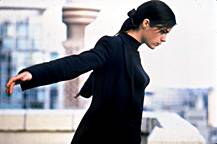
The film focuses on the life of a woman named Shawn, played to perfection by Selma Blair.

It seems that everything in Shawn's life is going absolutely horribly, and it's been that way for most likely her entire life.

On this day in particular, Shawn finds out that her boyfriend, who is also her married boss, has to cancel a trip for which Shawn has already bought them tickets, her father is so focused on his new baby that he cannot spare a five-minute phone conversation with her, and finally, once she gets to work, she discovers her boyfriend/boss' wife is pregnant.

Oh yeah. And her goldfish dies.

It is not only these events, but something more, something that has pervaded her life, that leads Shawn to the decision to kill herself. She goes to the top of the roof of the bank she works at with the intent to jump.

Photo credit: Haro

Meanwhile, the bank is being robbed by three men, one of whom runs to the roof. Using her as a way to get the police off his back, the man, named Charlie and played by the charismatic Max Beesley, takes Shawn “hostage” with a single promise.

If you help me out now, I'll kill you later.

And thus begins the journey of two polar opposite characters, a happy-go-lucky man without a care in the world and a depressed woman angry at the world. The film tells the story of how the two of them come to form a partnership of sorts, offering each other a sense of understanding that neither has ever experienced.

The film as a whole is one of those rare gems. Not only are the lead characters realistic and the plotline engaging, but everything else seems to come together like a well-oiled machine.

There are subplots involving the secondary characters throughout the film, all somehow relating to the main plot.

Photo credit: Bergman Lustig Productions

The cinematography is creative with transitions from close-ups and wide-shots and from slow-motion back to real time.  

One of my favorite sequences in the film occurs when the two leads are simply talking and getting to know each other better. The nearby clock is shown to be going backwards, and as the dialogue is heard, shots from different moments in time are shown out of order. This really captures the feeling of the moment, as well as reminds the audience of the importance of time, as the entire film takes place within a 24-hour period.

In the end, Lustig's film is a patchwork of elements that come together perfectly to tell a good story.

A story of a woman who, through a chance encounter, finds the power within herself she had long thought disappeared.


Coming up next in our Girl Power series:  Brokedown Palace (1999).

To return to the beginning of the series, click here.


Monday, March 4, 2013

A Hammer I Was Holding Fell On Them: Pieces of April (2003)

To start off our Girl Power series, I decided to begin with a high note.

Few films have the power to put me in a good mood like Peter Hedges' Pieces of April.

Released in 2003, April quickly became my go-to Thanksgiving film.

It tells the timeless tale of the “black sheep” of a family, a role I'm sure plenty of us have filled at least once in our lives.

It seems this feeling resurfaces for a lot of us particularly around the Holidays, which is why I find the setting of this film on Thanksgiving to be so fitting.

The main character, April, is a 21-year-old living on the Lower East Side of New York with her boyfriend, Bobby. April, who has spent her entire life being not only the outcast of her family, but also cast as the villain, offers to cook a Thanksgiving dinner for her family, due to the fact that her mother is suffering from breast cancer and it is unlikely that she will survive another holiday season.

The viewer sees throughout the film that April's mother, ironically named Joy, is an extremely bitter woman who has only grown more difficult with the progression of her disease. However, it is clear that her problems with April have existed practically since the younger woman's birth.

However, fate plays a part when April discovers her oven does not work, prompting her to go from door to door in her building, asking for help from her neighbors, who she has never interacted with before.

It is this chance occurrence that leads April to form a community, a family of sorts, with her neighbors, along with her boyfriend, who had been the first real support in her life.

Photo credit: Well Done Productions

In the end, it is films like this that remind us that family is not limited to blood, but those who are willing to help us in our time of need.

The fact that April's mother ultimately sees the error of her ways and makes peace with her eldest daughter is simply the icing on the cake.

Coming up next in our Girl Power series, Kill Me Later (2001).

To return to the beginning of the series, click here.

Monday, February 25, 2013

One of a Kind. Like Someone's Face: My Own Private Idaho (1991)

As many of you know, the Oscars were this past weekend, and like me, I'm sure you noticed the prevalence of one thing. Rain Phoenix.

Okay. So maybe I was the only one.  Nevertheless, each time the camera would focus in on Rain, I couldn't help thinking of her brother. No, not the one who pretended to have a drug problem in his infamous mockumentary, the one who sadly did succumb to one. The late River.

River's greatest artistic achievement was his role in the first film covered on this little blog adventure of mine, Gus Van Sant's My Own Private Idaho.

Released in 1991, My Own Private Idaho was a film that was definitely ahead of its time. By combining a modern day retelling of Shakespeare's Henry IV with the story of a homeless narcoleptic young man in search of his mother, Van Sant succeeded in proving that regardless of time period, the essential element of a good story is its characters.

Photo credit: One From RM


The character played by River Phoenix, Mike, broke a number of taboos held in Hollywood at the time.

The product of an incestuous relationship between mother and son, Mike is a young gay prostitute during the AIDS epidemic of the late 1980s-early 1990s. Yet, unlike what the mainstream media was characterizing boys and men like Mike as at the time, the film does not portray him as deviant or even unique. He is simply a boy looking for love.

Mike believes he has found that love in Keanu Reeves' Scott, the son of the mayor of Portland and the modern-day version of Henry IV. Scott immerses himself in Mike's world of street kids as a direct act of defiance against his prim and proper father.

Mike and Scott are a study in character contrast.  Van Sant emphasizes this difference blatantly through the use of Shakespearean-inspired dialogue whenever the film is focusing on Scott’s storyline.  Whenever we move back to Mike’s world, we are once again back to the everyday diction one would hear on the street.  By changing up the vocabulary, we are reminded of where Mike and Scott each come from, their backgrounds and what is ultimately expected of their future.

The character of Mike is exceptionally sympathetic, due in part to Phoenix’s authentic portrayal.  We see Mike as he falls into several of his narcoleptic fits.  His quiet, meek demeanor shows an endearing vulnerability that makes the viewer want to just take him home and give him a better life.  Like a lost puppy sitting on the curb in the pouring rain. 

Scott, on the other hand, is much more theatrical, and appropriately so, considering the inspiration for his character.  Scott goes out of his way to dress in overly “trashy” ways and make unnecessary scenes, all with the ultimate goal of displeasing and embarrassing his father.

The core difference between these two best friends is perhaps best summed up by a short moment in the film when they are confronted by a police officer.

Mike, being a kid of the streets his whole life, immediately runs, though he has not done anything wrong. Scott, not comprehending what the big deal is, watches confusedly as his friend dashes away, conversing with the cop as normally as he would anyone else.

This scene is immediately followed by what is considered by many, myself included, to be the most memorable moment in the film.  Stranded, the two boys are sitting around a campfire in the night when Mike at last confesses his feelings for Scott.

The confession is done in such a subtle and genuine way that the viewer can feel the emotions Mike is experiencing.  The fear.  The anxiety.  The longing.  Regardless of gender or sexual orientation, anyone can understand those feelings.  The pain of unrequited love.

Again demonstrating the pioneering quality of this film, though Scott does not return his friend's feelings, he accepts them and their friendship remains intact.

But sadly, the dream must end, the two boys' pasts rising from sleep to make themselves known once again.

Scott meets and supposedly falls in love with a young Italian woman, taking her back to the States with him, leaving Mike stranded in Italy. The two boys do not see each other again until after Scott has married the young woman and completely transformed himself into the man his father had always wanted him to be, becoming part of the world he had claimed to detest so much.

It is not until this far into the film, almost at the end, when the complexity of Scott's character is fully realized.

He becomes what his father had always wanted.  Does that mean that he was acting the entire time he was with Mike?  What about his relationship with Mike?  Did he never care about him at all or in fact plan to eventually leave him the whole time?

This theory would hold true if it were not for the subtle moments during Scott’s final scenes in the film.  When he is met with reminders of his past, confronted by the people he once knew, the ambivalence is clear on his face.  He yearns for the life he had with Mike, and yet he will not leave his new position.

The complexity of this moment just goes to show that this is not a fairy tale. There are no happy endings. Scott remains a member of high society while Mike continues living among the streets.  As the film ends, you feel as if you have come to know these characters on a strangely personal level.  It's like you've entered their world and come with them on this journey, seeing their innermost thoughts.  The fun, the love, the fear, the confusion.  The feeling of being young but still plagued by a sense of hopelessness.  This is encapsulated in the final frame.   The film closes with a shot of Mike, passed out from a narcoleptic episode, being picked up on the side of the road by a passing stranger.